| |
Wild Silk Moth (Saturniidae) Rearing Instructions by Jeffrey Keverline
Eggs
- Keep eggs in a see-through container, such as a plastic food or deli container with snap on lid. Air holes are unnecessary, but if present, should be very tiny and no larger than a pin-prick with a fine needle.
- Place the container in an area out of direct sun or extreme temperatures.
- DO NOT put foliage in the container with un-hatched eggs, even if a few larvae have already hatched. The CO2 given off by the cut foliage will suffocate any un-hatched eggs.
Larvae
- Transfer hatched larvae to leaves using a small paint brush. Be careful, the larvae hold on so tight that they can be ripped in half if pulled too hard from their footing. Allow them to walk onto the paint brush and gently pull them away.
- The best way to raise silk moth larvae is by sleeving. With this technique, the larvae are nourished by living leaves straight from the tree. Small larvae are prone to dessication and personally I have had very good results with sleeves but very high mortality on cut food, at least until the larvae reach the 3rd instar. A sleeve made from window screen stapled into a large tube can be placed over a branch and the larvae placed inside. Wash and shake the branch and then thoroughly inspect for predators (assassin bugs, spiders, lacewing larvae) before sleeving. Tie the ends with twine to keep predators out. Clean any frass (poop) by opening the end and tipping the sleeve down every so often, and especially before rain. Don’t overcrowd (no more than four 5th instar larvae per 36” sleeve) or allow the larvae to completely run out of leaves before moving to a fresh branch. If possible, set up enough sleeves so that the larvae will not run out of foliage through the course of their development. Sleeves can be “Texas rigged” with garden Fabric stapled or clipped to the top half of the sleeve to shelter larvae from the hot sun and torrential rains that occur in our area.
- Alternatively, cut branches can be placed in water and then set in a cage. Rinse the leaves, shake off excess water, and make sure no predators are present. Cut the stem at a 45⁰ angle and immediately immerse in water so the cut does not seal and prevent water uptake. It is VERY IMPORTANT to seal the opening of the container to keep larvae from walking down the stems and drowning themselves. Wrapping the stem with a collar of folded paper towel, inserting the stem into the water, and pressing the paper towel into a hole in the lid, or into the bottle works well. Change the water daily, and add fresh branches every couple days.
- Humidity and air movement are important and indoor air is usually too dry for early instar larvae, which will quickly dessicate. The branches and larvae should be placed in an outdoor location that does not receive direct sun but still gets indirect light and air movement. A screen cage or sleeve should enclose the container and foliage to protect larvae from predators. Rearing outside will also keep the larvae in sequence with wild moths in the area.
- When moving larvae to fresh branches, just lean the old branches with larvae against the new ones. The larvae will crawl onto the fresh leaves. If moving larvae to a new sleeve, sections of branch with the larvae attached can be cut and moved to the new sleeve. If this is not feasible, the larvae can be transferred using a paint brush for smaller larvae, or gently prodding them onto your hand or a stick, and then to the fresh leaves. If any larvae appear motionless and the head is tucked under, it may be preparing to molt. Avoid disturbing such larvae and definitely do not try to remove them from their footing until they have molted and hardened up. When removing a larger larvae from its footing do not pull hard, try to get it to walk onto your hand or a stick. Pulling hard can rip out the hooks on its prolegs, resulting in a caterpillar that cannot climb or hold on.
- To prevent disease, sleeves and cages should be thoroughly soaked in bleach water for 1 hour between uses. Frass buildup should be kept to a minimum, especially in wet weather. If any larvae show signs of disease, they should immediately be removed and isolated, or flushed down the toilet if dead. Wash hands thoroughly after handling such larvae.
- Larvae will discharge a sticky, black stool as they clear their gut before spinning a cocoon. Remove any leaves contaminated with this so other larvae do not eat it.
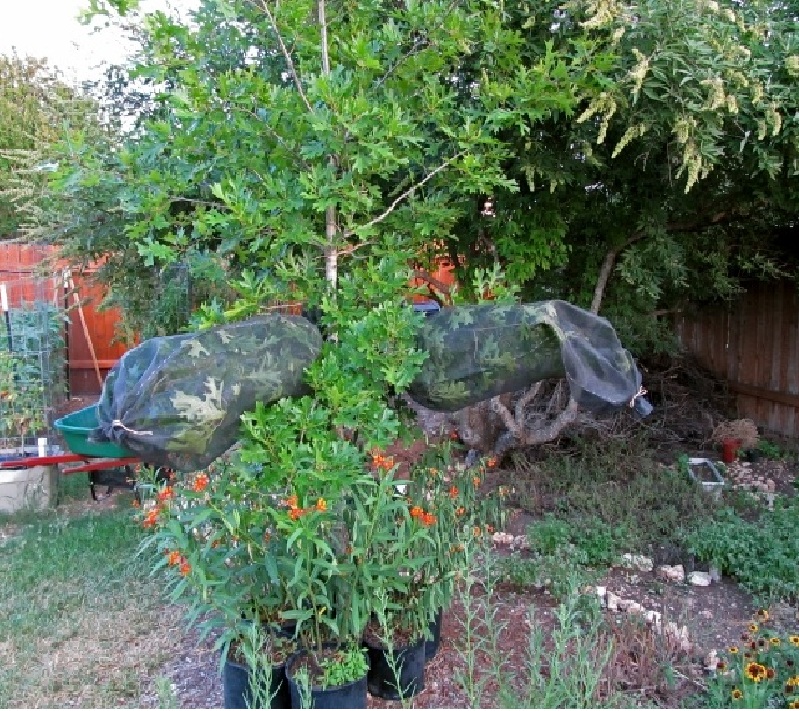
Shown above are sleeves, each containing about 75 hatchling A. polyphemus, on a Shumard red oak. I ended up clipping white cloth to the top half of both sleeves to shade the larvae.
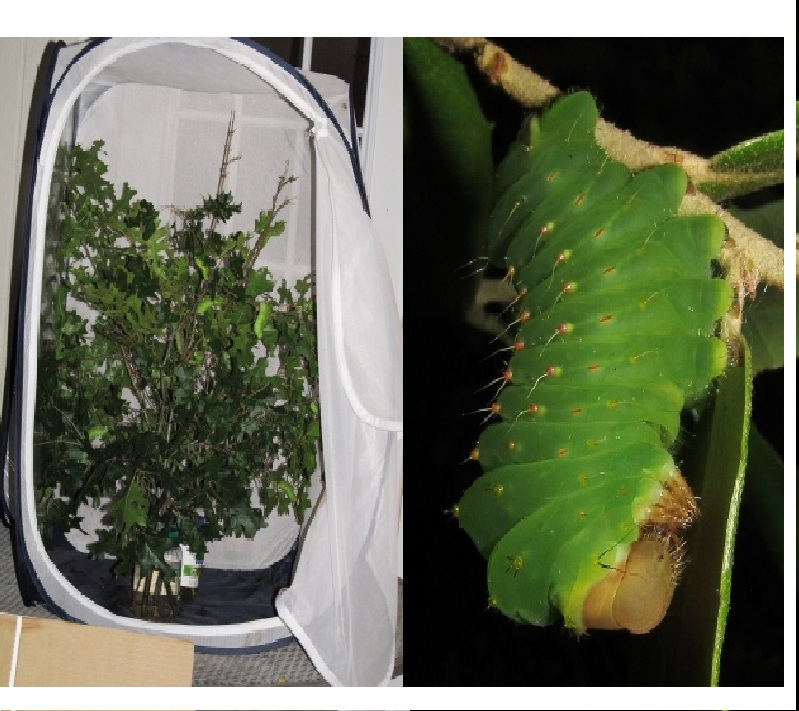
Left: Collapsible cage with 5th instar A. polyphemus. The oak branches are inserted into plastic jars with 1 inch holes that were cut with a utility knife and then smoothed using a flame from a lighter to melt the sharp edges. The water is changed and the frass cleaned out daily. The cage sits on my patio table and the cardboard at the lower left is clipped to the front to shield the cage from afternoon sun. The collapsible cages are available from livemonarch.com. Right: 4th instar A. polyphemus in premolt. Notice how the head is tucked under and the top of the new head capsule is visible behind the old. This larva should not be disturbed until after molting.
Cocoons
- Avoid disturbing a caterpillar that is spinning its cocoon and allow at least a week before moving the cocoon.
- Cocoons should be stored in as natural an environment as possible, so that when they hatch, they will be in sequence with wild moths and hatch at the same time. I store mine in elevated hardware cloth cages (no larger than ¼ inch mesh, or birds will snatch the moths from the outside) designed to allow airflow around all sides of the cocoon, including the bottom. They are hung out of direct sun (under a tree works great) and allowed to experience rain and other weather events. During prolonged heat waves or drought, a gentle but thorough spraying with water in the evening to wet the cocoons once or twice a week is advised.
- Cocoons should not be stacked on each other and ample vertical space with furnishings, such as sticks, angled piece of hardware cloth, or bark, should be provided in the enclosure for the eclosing adults to climb, hang, and expand their wings. The cage should be bird proof or put in a protected area when the moths are expected to hatch. A glass terrarium with a screen top and a few layers of paper towels on the bottom works well. Paper toweling can be secured with tape to the outside top edge of one side, draped over and down the inside, and the top placed over that to allow the moths to climb up the toweling and underneath the top to expand their wings. Keep the terrarium outside, but out of direct sun and in an area protected from rain, such as a patio. Be sure to mist the cocoons during dry spells.
- Cocoons spun during spring or summer usually eclose in about 4-5 weeks, except for Hyalophora cecropia, which will remain in the pupal stage until the following spring.
- If larvae pupate in the fall, the cocoons will likely overwinter. They can be left outside to experience a natural winter and will hatch the following spring. Here in Austin, early to mid March is the usual first flight time for our local silk moths.
Adults
- Adults should be released in a natural area with ample foodplants present and well away from bright lighting, such as gas stations, parking lots, stadiums, mercury vapor street lights, etc. Bright lights trap the moths and interfere with their mating. Mercury vapor lights, with their bluish white light, are especially bad. Areas with orange sodium vapor street lighting should be ok, as the moths are less distracted by this type of light, although the best area is one with no lighting at all. Since adults do not eat, they have around 3-5 days to reproduce before death.
- A “calling cage” can be fashioned out of ½” hardware cloth or similar large mesh material and a female placed inside. Suet bird feeders will work as a mating cage. The cage is then hung at dusk (after the birds roost for the night) upwind from a natural area known to have the same species, and away from lighting to allow the female to release pheromones, call in a wild male, and mate. Usually, the pair will mate right through the mesh. The pair will stay attached through the following day. Alternatively, a cylinder about 6 inches in diameter and 12 inches long can be fashioned out of hardware cloth and the female tethered inside. A thread is gently tied to the thorax of the moth by looping the thread between the front and hind wings and securing it with a few overhand knots. The moth is then tied to the center inside the cylinder with enough slack for her to wander around inside, but not over the ends. Regardless of cage design, it is important to return in the morning before it gets light and pick up the cage or the pair may become a very satisfying breakfast for a hungry bird! Gently move the cage and drive carefully to prevent startling or jarring the moths on the way home. Place the cage in a shady area safe from birds, cats, and extreme temperatures.
- When the pair separates (usually late in the afternoon), the female can be put into an inflated large paper grocery bag and the top paper clipped shut. She will begin to lay eggs when it gets dark. She will lay around 100 to 200 eggs the first night, so if only a few eggs are desired, watch her and then release her in a suitable area when she has laid the desired number of eggs. The eggs can be gently scraped off with fingernails or sections of paper with eggs cut out. Eggs hatch around 8-14 days depending on species and temperature.
Preferred Foodplants
While many foodplants are accepted, below are the preferred foodplants for some of our local wild silk moths:
- Antheraea polyphemus: Oak (any type will do, but they especially relish red oak), Wax myrtle
- Hyalophora cecropia: Mexican plum, Wax myrtle, Dogwood
- Actias luna: Sweetgum, Pecan, Hickory, Walnut, Sumac, Persimmon
- Automeris io: Oak, Ash, Dogwood, Hackberry, Plum
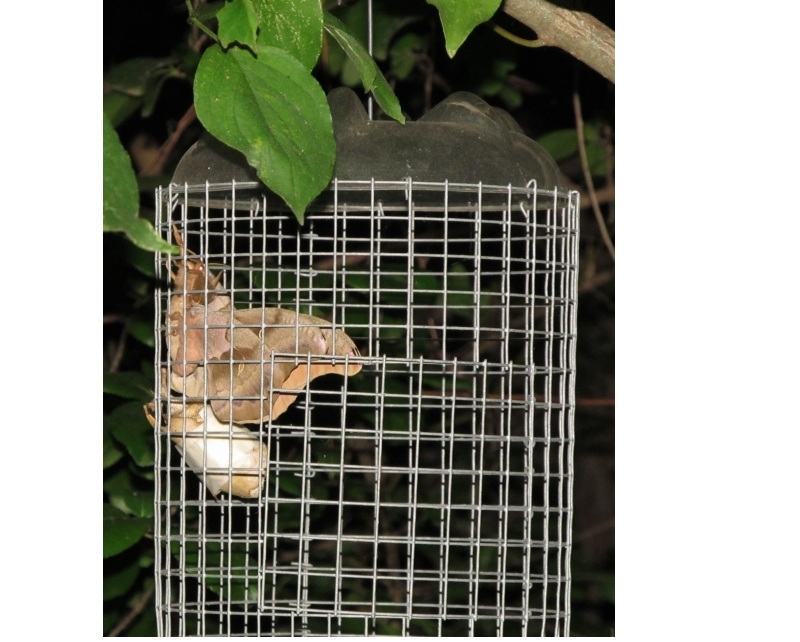
8 inch x 10 inch calling cage with A. polyphemus pair mating inside. I arrived at first light and the male was circling the cage. Often, males will mate through the mesh but this one was a bit reluctant. I opened the door and slowly guided the male to the opening with my hands. He went in and immediately paired with the female. The pair mated until late afternoon. The female was placed into a large paper grocery bag and laid over 100 eggs the following night!
Additional resources:
- www.silkmoths.bizland.com/indexos.htm, Perhaps the best resource on the internet and well worth the one time membership fee of $45. Bill Oehlke's site has detailed information and pictures of thousands of Saturniidae species from around the world. There are many how-to articles, newsletters, and also livestock for sale.
- www.wormspit.com, Good site with documentation of each stage for several species, also information on using wild silk.
- www.bugguide.net, One of the most informative websites on insects, arachnids, and myriapods.
- www.butterfliesandmoths.org, Excellent website with searchable regional species lists, records of sightings, and detailed information for most species.
- www.livemonarch.com, Collapsible cages, sleeves, and other supplies are available here.
- www.bioquip.com, Collapsible cages, books, black lights, insect nets, and many other supplies for the serious entomologist can be found here.
|


